Wisconsin CDL applicants begin with the Wisconsin Department of Transportation (WisDOT) and complete the road test through an authorized third-party examiner. The state currently provides CDL knowledge tests without a separate testing fee, charges $30 for a commercial learner permit (CLP), and requires at least 80% to pass each knowledge test.
The process is more than memorizing questions. Your vehicle class, endorsements, medical category, Entry-Level Driver Training (ELDT), test vehicle, and final restrictions all affect what work you may legally perform.
Current medical-record rule: For examinations performed on or after April 13, 2025, WisDOT says FMCSA sends the medical examination result electronically, generally within 48 hours. WisDOT no longer accepts a paper card, email, fax, or online upload for those examinations. Confirm that the record reached WisDOT before a CDL transaction or deadline.
Wisconsin CDL Quick Facts
| Item | Current Wisconsin requirement |
|---|---|
| Licensing agency | Wisconsin Department of Transportation (WisDOT) |
| Existing license | Present a valid Wisconsin Class D license when testing |
| Knowledge-test passing score | 80% |
| Knowledge-test fee | No separate fee; no appointment is required |
| Core application forms | MV3001 Driver License Application and MV3230 Commercial Driver Certification |
| CLP fee and validity | $30; valid for 180 days |
| Minimum CLP holding period | At least 14 days before skills testing |
| Original CDL fee | $74, prorated to the expiration date of the current license |
| CDL renewal | $74 for eight years |
| Class upgrade | $15 |
| Endorsement upgrade | $5 plus a $10 issuance fee |
| Third-party skills test | Up to $150 for the complete test or $50 per segment |
| ELDT | First Class A/B, B-to-A upgrade, and first H/P/S endorsements |
| Official handbook | Wisconsin Commercial Driver’s Manual |
Medical examinations, ELDT, vehicle rental, fingerprints, retesting, and provider services are separate from the state fees above. Always confirm current totals with WisDOT and the selected examiner before paying.
Wisconsin Knowledge Tests and Practice Modules
The required tests depend on the vehicle and work. General Knowledge is required for every CDL. Class A applicants normally also need Combination Vehicles; applicants testing in an air-brake-equipped vehicle need Air Brakes knowledge. Add endorsement tests only when the job requires them.
- General Knowledge diagnostic
- Air Brakes diagnostic
- Combination Vehicles diagnostic
- Hazardous Materials diagnostic
- Tanker diagnostic
- Doubles and Triples diagnostic
- Pre-Trip Inspection diagnostic
WisDOT recommends allowing about 60 to 90 minutes for knowledge testing. Tests are available at DMV service centers without an appointment, but service hours can vary. Bring the current Class D license and the completed forms rather than assuming the DMV can reconstruct missing information.
Wisconsin CDL Application Steps
1. Choose the correct class and endorsements
Use the gross vehicle weight ratings, trailer rating, passenger capacity, and cargo—not the vehicle’s appearance—to determine Class A, B, or C. Identify whether the job needs air brakes, tank, passenger, school bus, HazMat, or doubles/triples qualifications before taking tests.
2. Determine the medical operating category
Complete the MV3230 Commercial Driver Certification and select the correct interstate or intrastate, excepted or non-excepted category. A non-excepted applicant generally needs a valid federal medical qualification. Incorrect self-certification can limit or disqualify commercial driving privileges.
For medical exams completed on or after April 13, 2025, allow time for electronic transmission from FMCSA. Contact WisDOT if the record has not appeared; do not mail or upload a paper card as a substitute under the current process.
3. Complete MV3001 and visit a DMV service center
Bring the Wisconsin Class D license and required identity or status documents for the transaction. Take the knowledge tests for the selected class and endorsements. Each test requires 80%.
4. Obtain and hold the CLP
The $30 CLP is valid for 180 days. Hold it for at least 14 days before the CDL skills test. A properly licensed CDL holder must supervise practice, and both the class and endorsements must cover the practice vehicle. Passenger and school-bus CLPs carry additional restrictions.
WisDOT permits CLP renewal, but renewing has an important consequence: previously passed skills-test segments do not carry into the renewed permit. Plan training and testing so an expiring permit does not erase partial progress.
5. Complete ELDT when required
Use a provider listed in the FMCSA Training Provider Registry when obtaining a first Class A or B CDL, upgrading Class B to A, or adding a first HazMat, passenger, or school-bus endorsement. Confirm the provider has posted completion before skills testing or the HazMat knowledge-test step that requires it.
6. Select an authorized third-party examiner
Wisconsin uses approved third-party CDL examiners. The maximum charge is $150 for the complete test or $50 for an individual segment. Ask separately about vehicle rental, cancellation, no-show, and retest charges.
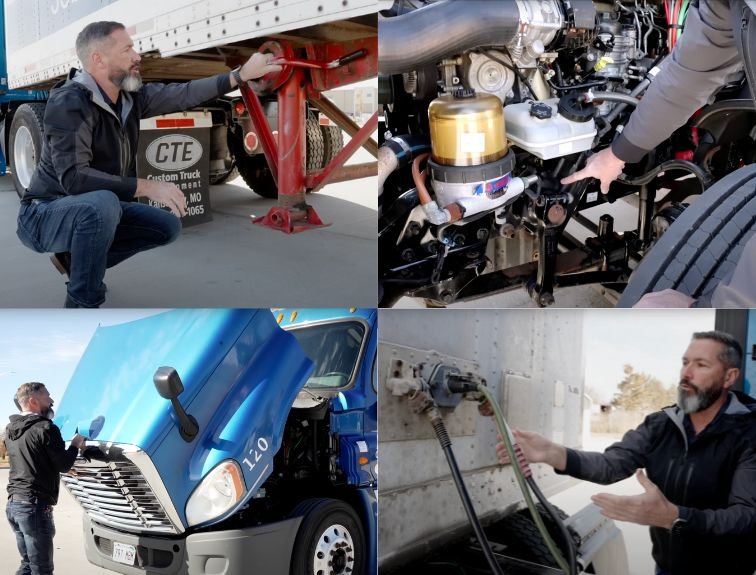
The test has three segments: vehicle inspection, basic control skills, and on-road driving. Bring a safe, properly registered and insured representative vehicle. Testing in an automatic transmission or without a full air-brake system may place restrictions on the CDL.
7. Return for CDL issuance
After passing, complete the licensing transaction and inspect the credential. Verify class, endorsements, medical status, intrastate restriction if applicable, transmission restriction, and air-brake restriction before accepting it.
Wisconsin-Specific Preparation
- Winter traction: Increase following distance before bridges, shaded pavement, ramps, and open rural stretches. Avoid abrupt steering or braking and never allow schedules to override safe speed.
- Downgrades and heat: Select a safe gear before descending and use controlled braking. Snow does not eliminate brake-fade risk on long grades or heavy loads.
- Dairy and liquid loads: Tank vehicles can surge even when the tank is not permanently attached. Verify when the N endorsement is required and study outage, bulkheads, and smooth control.
- Interstate corridors: I-39, I-41, I-43, I-90, and I-94 combine urban traffic, work zones, wind, and winter exposure. Practice mirror checks, lane control, railroad crossings, and safe ramp speed.
- Vehicle restrictions: The test vehicle determines possible restrictions. A tractor-trailer applicant who tests in an unrepresentative configuration may not receive the authority expected for the job.
Wisconsin HazMat and School Bus Notes
HazMat applicants must complete the federal threat-assessment process in addition to Wisconsin testing and ELDT requirements. WisDOT’s current fee table lists a HazMat endorsement transaction at $67.25, or $57.25 when completed with renewal, plus a separate $23.75 Fieldprint fingerprint fee. Confirm the sequence and current appointment instructions before visiting the DMV.
Passenger and school-bus applicants need the appropriate knowledge and skills tests. School-bus applicants also face state-specific background, physical, and employer requirements. Passing a general CDL test alone does not authorize school-bus operation.
Official Sources
- WisDOT — CDL requirements
- WisDOT — driver license and CDL fees
- WisDOT — third-party CDL skills testing
- Wisconsin Commercial Driver’s Manual
- WisDOT — driver forms and handbooks
- FMCSA Training Provider Registry
Wisconsin CDL FAQ
Are Wisconsin CDL knowledge tests free?
WisDOT currently lists no separate fee for the knowledge tests, and an appointment is not required. The $30 CLP fee is charged when the permit is issued.
How long is the Wisconsin CLP valid?
It is valid for 180 days and must normally be held for at least 14 days before skills testing. Renewing the permit voids any skills-test segments previously passed on that permit.
Can I submit my medical card directly to WisDOT?
For examinations performed on or after April 13, 2025, WisDOT says the result is transmitted electronically from FMCSA. Paper, email, fax, and online upload are no longer accepted for those exams.
Does the $150 skills-test cap include a truck rental?
Not necessarily. The cap covers the test charge described by WisDOT. Ask the examiner about vehicle rental and other provider fees before scheduling.