
Tennessee applicants move through a state-specific document and fee process before the federal training and skills-test requirements come into play. The Department of Safety and Homeland Security issues the credential; eligible Driver Services Centers and certified third-party organizations provide skills testing. Choose Class A, B, or C before taking knowledge exams so the permit and test vehicle match the work you intend to do.
Last verified: September 9, 2026.
Tennessee CDL Quick Facts
| Item | Current Tennessee requirement |
|---|---|
| CDL agency | Tennessee Department of Safety and Homeland Security |
| Minimum age | 18; applicants under 21 are restricted to Tennessee intrastate operation |
| Class A CLP | $14 total for one year |
| Class B or C CLP | $13 total for one year |
| Class A CDL | $70 total for the standard eight-year term |
| Class B or C CDL | $62 total for the standard eight-year term |
| Standard endorsement | Tanker, passenger, HazMat, and doubles/triples are listed at $8.50 total when added; school bus is $26 |
| Skills testing | Appointment at an eligible state center or with a certified third-party tester |
| Official handbook | Download the Tennessee Commercial Driver License Manual (PDF) |
Third-party testers may charge their own skills-test fees. County Clerk partners may also add the administrative amount identified on the state fee page, so verify the total for the location you use.
Required Tennessee Documents
Tennessee’s official checklist calls for a valid DOT medical certificate, proof of Social Security number, a Tennessee driver license or qualifying out-of-state license, two proofs of Tennessee residence, and proof of U.S. citizenship or lawful permanent resident status. Documents must be original; the state says photocopies are not accepted. Many residency items must be current and issued within the preceding four months.
Do not assume every document showing an address qualifies. Tennessee’s CDL checklist specifically says bank statements, credit-card statements, and cellular-phone bills are not accepted as residency evidence. Use two documents from the state’s current accepted list and, when the checklist requires it, make sure they come from different sources.
Document verification can delay issuance. Compare the spelling of your full legal name across the medical card, Social Security evidence, license, and identity document before the appointment.
Choose Your Tennessee Practice Module
| Your goal | Knowledge area | Start here |
|---|---|---|
| Initial CLP | General Knowledge | General Knowledge diagnostic |
| Class A combination | Combination Vehicles | Combination diagnostic |
| Air-brake CMV | Air Brakes | Air Brakes diagnostic |
| HazMat endorsement | Hazardous Materials | HazMat diagnostic |
| Tank vehicle | Tank Vehicles | Tanker diagnostic |
| Double/triple trailer | Doubles and Triples | Doubles diagnostic |
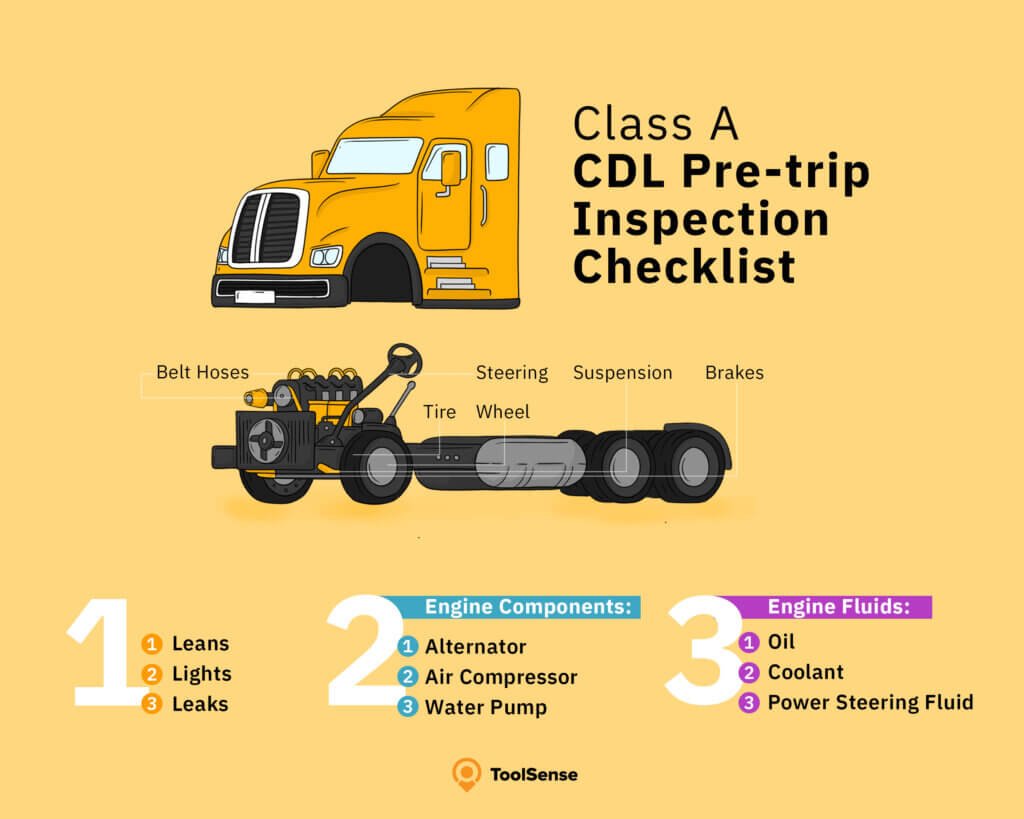
| Skills test | Pre-trip inspection | Pre-Trip diagnostic |
Tennessee CDL Application Steps
- Select the vehicle class and endorsements. A Class A permit costs differently from a Class B/C permit and requires different knowledge coverage.
- Study the official manual. General Knowledge is the base; add Combination, Air Brakes, Passenger, School Bus, Tanker, Doubles/Triples, or HazMat as required.
- Gather original documents. Include two current Tennessee-residency proofs and the medical documentation required for your operating category.
- Take the knowledge exams at a Full-Service Driver Services Center. Pass every exam required for the CLP class and endorsements you want to practice.
- Receive and hold the CLP. Federal rules require at least 14 days before the skills test.
- Complete applicable ELDT. A provider in the FMCSA registry must report completion before covered Class A/B, upgrade, passenger, school bus, or HazMat testing.
- Schedule the skills test. Tennessee publishes a state scheduling number and a list of certified third-party organizations. Confirm the tester handles your class and endorsement.
- Bring a representative vehicle. Its transmission, brake system, fifth-wheel connection, class, and passenger capacity can determine restrictions on the issued CDL.
Tennessee e-Services and Medical Self-Certification
Every Tennessee CDL holder must file a Self-Certification Affidavit when applying, transferring a CDL, renewing, moving to a higher class, or adding an endorsement. The affidavit identifies one of four federal operating categories. Many interstate carrier jobs fall under non-excepted interstate operation, but the correct category depends on the work you actually perform.
Tennessee implemented the federal National Registry II medical-certification process on June 15, 2025. Certified medical examiners now transmit examination results electronically to FMCSA and the state. Tennessee says a paper Medical Examiner’s Certificate (MCSA-5876) is no longer accepted as proof that you passed the physical. You still need to submit the Tennessee Self-Certification Affidavit through e-Services or at a Driver Services Center so the state can associate the correct operating category with your record.
Check that the name, date of birth, and driver-license information used by the medical examiner match your Tennessee record. A mismatch can prevent the electronic result from posting. For a renewed medical certification, Tennessee advises completing the physical and submitting the required self-certification information at least five business days before expiration. If the medical status expires, commercial driving privileges are removed and restoration may require additional fees or testing.
Entry-Level Driver Training
ELDT applies to a first Class A or B, a Class B-to-A upgrade, and first-time Passenger, School Bus, or HazMat endorsements. It is not satisfied by taking random online questions: the provider must be registered and submit completion to FMCSA.
Tennessee CDL Renewal
Tennessee’s current renewal instructions require holders of a Class A, B, or C commercial license to renew in person at a Driver Services Center and bring valid medical certification. Do not rely on older pages that describe general online license renewal as if it applies to a CDL. The department may mail a courtesy notice roughly eight to ten weeks before expiration, but receiving that notice is not required to renew and the driver remains responsible for the deadline.
Before going to the center, confirm that your medical result appears correctly, prepare the same identity and residency evidence requested by the current checklist, and check whether any HazMat or other endorsement requirement must be completed separately.
Tennessee-Specific Study Priorities
- Eastern grades: Practice selecting a safe gear before descending, proper brake use, escape-ramp awareness, and downgrade speed management.
- Restriction prevention: An automatic-transmission or air-brake-limited test vehicle can narrow the equipment you may legally operate.
- Inspection language: Learn components as systems rather than memorizing one script; the examiner must see that you recognize unsafe conditions.
- Appointment planning: State and third-party availability differs. Confirm the date, required documents, vehicle, insurance, and tester fee before arriving.
Official Sources
- Tennessee Department of Safety: Commercial Driver License
- Tennessee Department of Safety: Required CDL Documents
- Tennessee Department of Safety: Medical Certification Requirements
- Tennessee Department of Safety: Driver License Renewal
- Tennessee Department of Safety: Driver License Fees
- Tennessee Department of Safety: Commercial Driver License Manual (PDF)
- FMCSA: Entry-Level Driver Training
FAQ
How much does a Tennessee Class A learner permit cost?
The state fee page lists $14 total for a one-year Class A learner permit. Class B or C is listed at $13.
How much is a standard Tennessee CDL?
Tennessee lists Class A at $70 total and Class B or C at $62 total for the standard eight-year credential, before optional endorsements or third-party testing fees.
Where do I take the skills test?
Use an eligible state Driver Services Center by appointment or schedule directly with a Tennessee-certified third-party testing organization.