Texas adds a required Texas Commercial Rules knowledge exam to the federal CDL subjects, and the state changed an important testing rule in 2026: effective June 1, all Texas CDL and CLP knowledge exams are administered in English only.
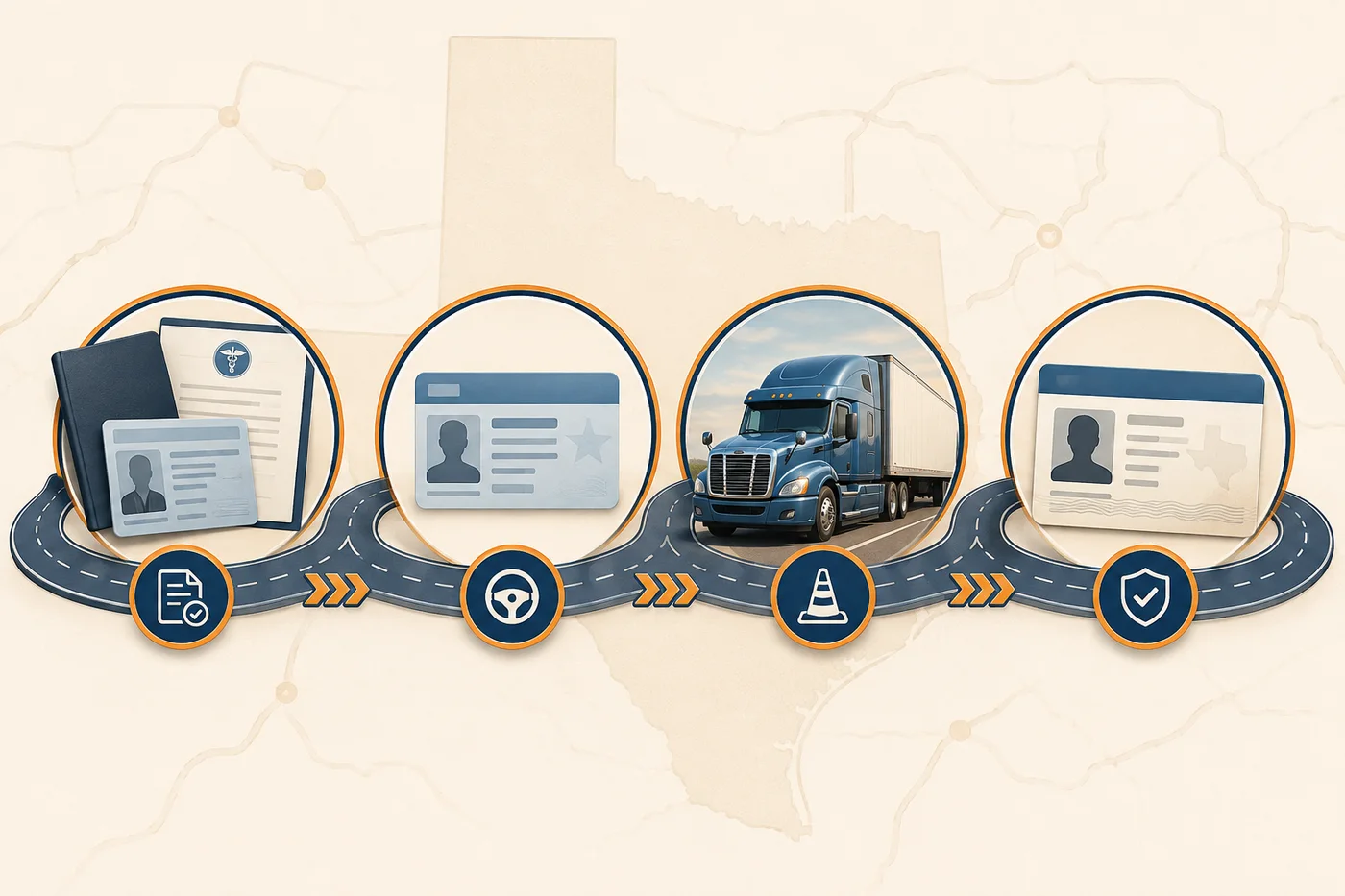
This guide organizes the official Texas DPS requirements into one path: choose the correct CDL class, gather the required documents, obtain the CLP, complete any applicable ELDT, pass the skills test, and receive the CDL. Detailed test preparation belongs on the linked subject pages rather than being duplicated here.
Verified September 6, 2026: Requirements, fees, test order, and handbook links on this page were checked against current Texas DPS and FMCSA sources. Always confirm appointment availability and personal eligibility with Texas DPS.
Texas CDL Quick Facts
| Item | Current Texas requirement |
|---|---|
| Licensing agency | Texas Department of Public Safety (DPS) |
| Knowledge-test language | English only, effective June 1, 2026 |
| Passing score | 80% or higher on each knowledge-test section |
| Original CLP fee | $25 |
| CLP validity | 180 days or until the base Texas license expires, whichever comes first |
| Minimum CLP holding period | 14 days before the CDL skills test |
| New CDL fee, age 18–84 | $97; Texas DPS lists an eight-year term |
| Skills test | Vehicle Inspection, Basic Vehicle Control, and On-Road Driving |
| Official handbook | Texas Commercial Motor Vehicle Drivers Handbook (DL-7C) |
| Application | Texas Commercial Driver License Application (CDL-1) |
Important: The Impact Texas Drivers program applies to specified non-commercial driver-license paths. The official Texas CDL application process does not list an “Impact Texas Commercial Drivers” course as a CDL requirement. For CDL applicants, the applicable training requirement is ELDT through an FMCSA-registered provider.
Phase 1: Eligibility and Documentation
Before visiting DPS, use the official application page to confirm the documents required for your situation. First-time CDL applicants must already hold a valid Texas driver license before receiving a CLP.
Age Requirements
- 18 years old - Can get a CDL but restricted to intrastate driving only (cannot cross state lines)
- 21 years old - Full interstate CDL, can drive anywhere in the country
Documents Texas DPS Requires
Texas DPS lists the following core CLP requirements:
- A valid Texas driver license
- Proof of U.S. citizenship or lawful presence
- Proof of identity
- A Social Security Number that can be electronically verified
- Medical self-certification using the applicable CDL-4, CDL-5, or CDL-10 form
- A Medical Examiner’s Certificate when required by the selected medical category
- Current Texas registration and insurance for vehicles you own when the new-resident rules apply, or the appropriate no-vehicle statement
Start with the official Texas DPS CDL application instructions instead of relying on a generic document checklist.
Medical Certification (DOT Physical)
When a medical certificate is required, use an examiner listed on the National Registry of Certified Medical Examiners. The provider sets the exam price, and the examiner determines the certificate period based on the medical evaluation.
When you apply at the DPS, you will self-certify your driving category on Form CDL-4 or CDL-10:
- Non-Excepted Interstate (NI) - for drivers who cross state lines (most OTR and regional drivers)
- Non-Excepted Intrastate (NA) - for Texas-only drivers
Select the category that accurately describes your operation; the medical-certification requirements differ by category.
The Application and DPS Appointment
Complete the official CDL-1 application, then schedule an appointment with a Texas driver license office. At the office, DPS verifies the documents, collects the fee and biometrics, performs the vision exam, and administers the required knowledge tests.
Phase 2: The Commercial Learner’s Permit (CLP)
You must hold a CLP for at least 14 days before you can take the skills test. But first you need to pass the written exams.
The Written Tests
At the DPS office, you will pay the $25 original CLP fee, take a vision test, and complete the knowledge exams that match your intended vehicle and endorsements. Texas DPS administers the exams in this order:
- Texas Commercial Rules: State-specific commercial vehicle requirements covered in Section 14 of the Texas handbook.
- General Knowledge: Required for CDL applicants.
- Combination Vehicles: Required when applicable, including a typical Class A combination.
- Air Brakes: Required when applicable to avoid an air-brake restriction.
- Doubles/Triples, Passenger, School Bus, Tanker, and HazMat: Added when required for the intended operation.
Each section requires a score of 80% or higher. Under the current Texas handbook, an unsuccessful knowledge-test application remains active for 90 days; it becomes void if the required tests are not completed within that window or after three failed attempts, whichever comes first. Reapplying requires a new application, fees, and testing.
2026 language rule: Texas CDL and CLP knowledge exams have been English only since June 1, 2026. Interpreters are prohibited. The skills-test components are also conducted in English.
CLP Restrictions
While holding a CLP, you can only drive:
- When accompanied by a fully licensed CDL holder of the same or higher class, sitting in the passenger seat
- You cannot transport passengers or hazardous materials, and you cannot operate a double/triple trailer combination
- The CLP is valid for 180 days or until the base Texas driver license expires, whichever comes first
- Texas DPS permits one CLP renewal, beginning up to 30 days before expiration, without retaking the knowledge exams
Phase 3: Complete Entry-Level Driver Training When Required
Federal Entry-Level Driver Training (ELDT) applies when you are:
- Getting a Class A or Class B CDL for the first time
- Upgrading an existing Class B CDL to Class A
- Adding a Passenger (P), School Bus (S), or Hazardous Materials (H) endorsement for the first time
You may obtain a CLP before completing ELDT. However, the required ELDT record must be submitted by a registered provider and visible in the federal Training Provider Registry before the applicable skills test. For a first-time HazMat endorsement, the training requirement applies before the knowledge test.
Before paying a school, verify it in the FMCSA Training Provider Registry. FMCSA does not set one universal number of training hours or one Texas tuition price, so compare providers by registration status, included behind-the-wheel training, vehicle access, schedule, refund terms, and total cost.
Correction to older Texas CDL advice: The Impact Texas Drivers program is not listed as a requirement in the Texas DPS CDL application process. Do not delay a CDL application waiting for an ITD certificate. The training requirement that may apply to a CDL applicant is federal ELDT.
Phase 4: The Skills Test
For a first CDL, a Class B-to-A upgrade, or a first Passenger or School Bus endorsement, you must hold the CLP for at least 14 days before taking the skills test. Complete any applicable ELDT first and confirm your provider has submitted the result.
Where You Can Test
- Texas DPS: Schedule at a designated CDL testing location through the official DPS process.
- Authorized CDL Third-Party Skills Testing (TPST) provider: Texas permits approved schools, employers, and other organizations to test eligible students or employees. Eligibility, availability, and provider charges vary. Check the official Texas CDL TPST page before relying on a provider.
Bring a vehicle that represents the CDL class and restrictions you want. Confirm appointment-specific document, registration, insurance, and vehicle requirements directly with the testing location.
What the Skills Test Covers
The test has three parts:
- Pre-Trip Inspection: Walk around the vehicle and identify every component the examiner asks about. Name each part in English, describe what you are checking, and state the condition.
- Basic Vehicle Control: Texas’s modernized exercises include Forward Stop, Straight-Line Backing, Forward Offset Tracking, and Reverse Offset Tracking.
- On-Road Driving: Drive a predetermined route on public roads. The examiner evaluates lane usage, turning, intersection behavior, speed management, and mirror usage.
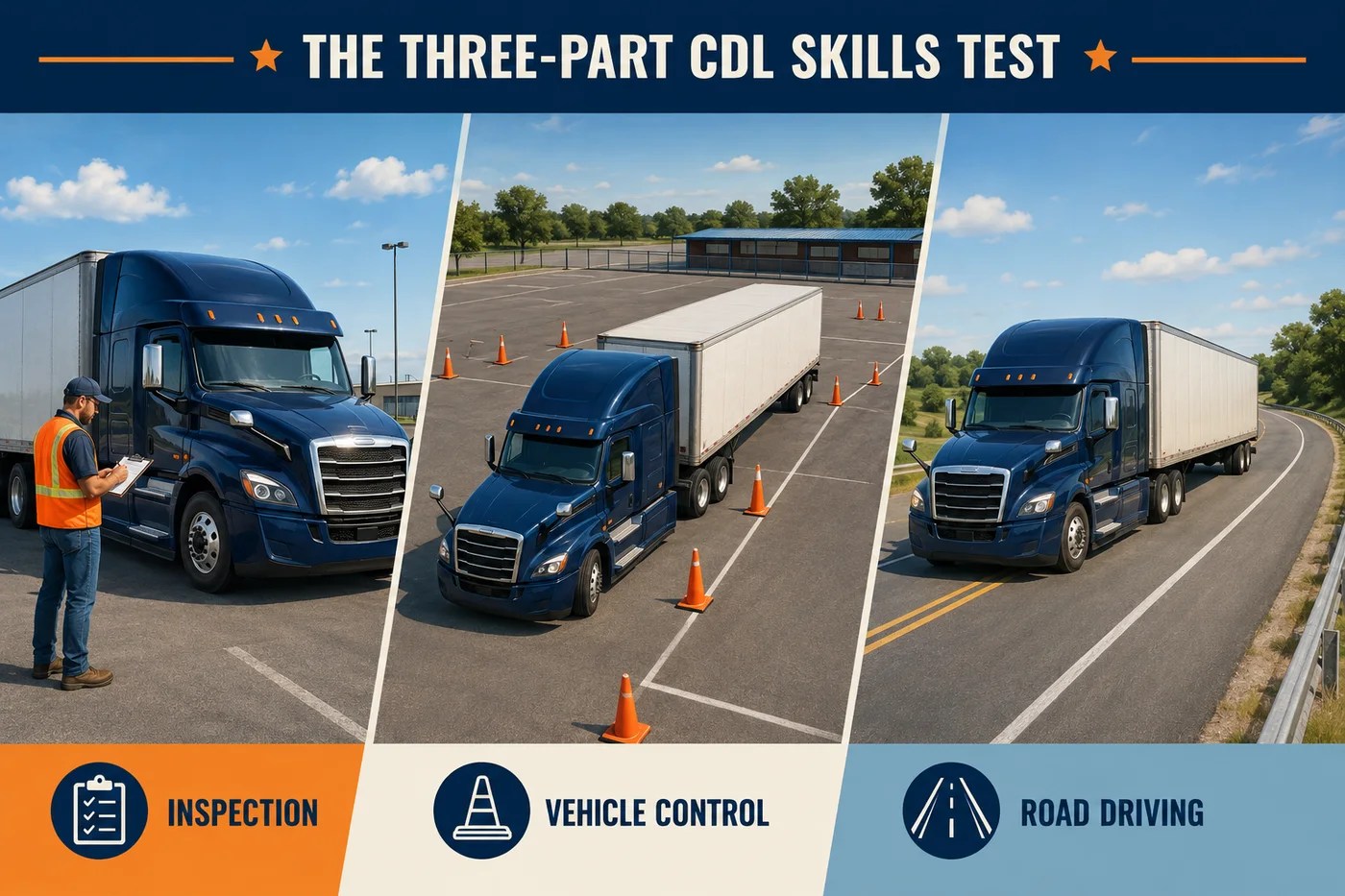
The three parts are taken in sequence, and you must pass each part before advancing. Texas DPS also publishes CDL skills-test instructional videos explaining the modernized test.
Continue With the Correct Texas Study Page
After confirming which tests DPS assigned, use one page per intent: download and navigate the Texas manual, prepare for General Knowledge, study Texas Commercial Rules, or follow the separate Texas HazMat endorsement process. This requirements page intentionally does not reproduce those study guides.
Texas CDL Fees Summary
| Item | Cost |
|---|---|
| Original Texas CLP | $25; valid for 180 days or until the base license expires |
| Texas CLP renewal | $25 |
| New or renewed Texas CDL, age 18-84 | $97; expires after eight years |
| New or renewed CDL with HazMat endorsement, age 18-84 | $61; expires after five years |
| Replacement CDL or CLP | $11 |
| Medical exam, ELDT, TPST, or training vehicle | Varies by provider; not a fixed Texas DPS license fee |
These are the core Texas DPS license fees for applicants age 18-84. Check the official Texas driver-license fee page before applying because age, endorsement, and transaction type can change the amount.
How Long the Texas CDL Process Takes
Texas sets a minimum 14-day CLP holding period for the applicants described above, but it does not promise a fixed total completion time. Your timeline depends on:
- How quickly you collect identity, residency, medical, vehicle, and insurance documents that apply to you
- Knowledge-test preparation and whether retesting is needed
- ELDT completion when required
- DPS or eligible TPST skills-test availability
- Access to a representative test vehicle
The safest plan is to complete documents and medical self-certification first, pass the knowledge exams and receive the CLP, use the 14-day holding period for ELDT and behind-the-wheel preparation, then take the three-part skills test at the first suitable appointment.
Conclusion
Getting a Texas CDL is easier when you follow the official order: confirm the class and endorsements you need, prepare the required documents, pass the English-only knowledge exams, hold the CLP for the required period, complete ELDT when applicable, and pass all three skills-test sections.
Start with the Texas Commercial Driver License page and the current Texas Commercial Motor Vehicle Drivers Handbook. Then use the test map above to practice only the modules required for your vehicle and job.
Official Texas CDL Sources
This guide was checked against official sources on September 6, 2026:
- Texas DPS: How to apply for a CDL
- Texas DPS: Commercial Driver License hub
- Texas Commercial Motor Vehicle Drivers Handbook
- Texas DPS: Driver license fees
- Texas DPS: CDL Third-Party Skills Testing
- FMCSA: Entry-Level Driver Training
Frequently Asked Questions (FAQ)
How long does it take to get a CDL in Texas?
Texas requires applicable applicants to hold the CLP for at least 14 days before the skills test. Total time varies with documents, ELDT or other training, test readiness, vehicle access, and DPS or eligible TPST appointment availability.
Are Texas CDL knowledge tests available in Spanish?
No. Texas CDL and CLP knowledge exams have been administered only in English since June 1, 2026, and interpreters are prohibited. The skills-test components are also conducted in English.
What is Section 14 on the Texas CDL test?
Section 14 is the Texas Commercial Rules test - a Texas-specific exam that covers state regulations including vehicle lighting, maximum vehicle height (14 feet), and special traffic laws. It is separate from the federal General Knowledge test and catches many applicants who only studied the national manual.
Can I take the Texas CDL road test with a third party?
Texas authorizes CDL Third-Party Skills Testing providers. These providers test eligible students or employees of approved programs, so confirm your eligibility, appointment availability, and any provider charge before choosing this route.
How much does it cost to get a CDL in Texas?
For applicants age 18-84, the official Texas DPS fee table lists $25 for an original CLP and $97 for a new eight-year CDL. A CDL with a HazMat endorsement is listed at $61 for five years. Medical exams, ELDT, third-party testing, and vehicle access are separate and vary by provider.
Do I need to complete ELDT training before the CDL test in Texas?
ELDT applies to first-time Class A or Class B applicants, Class B-to-A upgrades, and first-time H, P, or S endorsements. You may get the CLP first, but applicable ELDT completion must be recorded in the FMCSA Training Provider Registry before the skills test; first-time HazMat applicants need the applicable training before the knowledge test.