
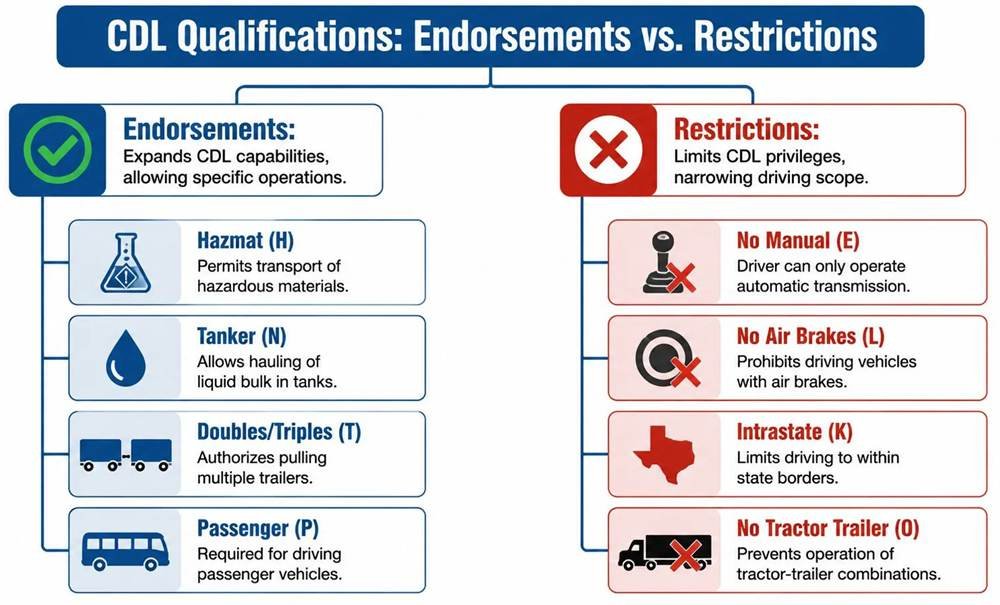
If a restriction is blocking a job, the letter itself is only half the answer. You need to know what caused it and what test vehicle or knowledge area changes the result.
Use this page to build that action plan. Then confirm the exact application, permit, testing, and fee requirements with your state licensing agency before paying for another test.
CDL Restriction Action Table
| Code | What it blocks | Common reason it appears | Practical next step to verify with your state |
|---|---|---|---|
| L | Any air-brake-equipped CMV | Air-brake knowledge or skills requirements were not met | Prepare Air Brakes and ask whether both knowledge and skills testing are required |
| Z | CMVs with full air brakes | Skills test used air-over-hydraulic brakes | Retest in a representative vehicle with full air brakes |
| E | Manual-transmission CMVs | Skills test used an automatic transmission | Retest in a manual-transmission CMV |
| O | Tractor-trailer CMVs | Class A test vehicle did not use a fifth-wheel connection | Retest in a qualifying tractor-trailer |
| M | Class A or B passenger vehicles | Passenger skills test was completed in a Class C passenger vehicle | Retest in the passenger-vehicle class you need |
| N | Class A or B passenger vehicles | Passenger skills test was completed in a Class B vehicle | Retest in a Class A passenger vehicle if that is the target |
| K | Interstate commercial operation | Driver is restricted to intrastate operation | Resolve age, medical, or state eligibility issue before requesting removal |
| V | Operation outside a medical variance | Federal medical variance is on the driver record | Follow the variance and medical-certification process; this is not a simple vehicle retest |
States can add their own restriction codes and administrative steps. If your license shows a combined or unfamiliar code, use the definition printed in your state CDL manual.
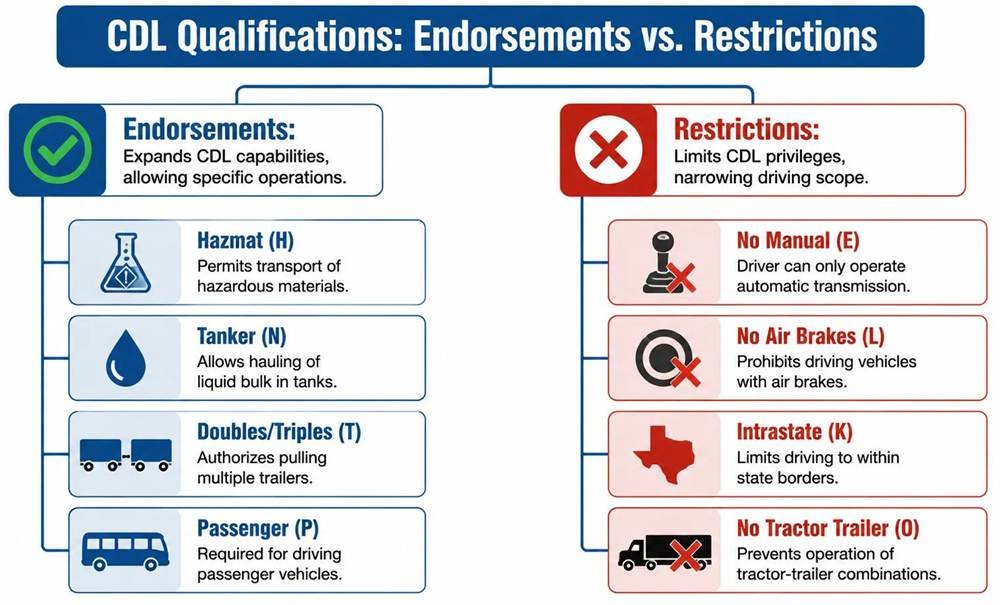
The Two Restrictions That Most Often Need Test Preparation
L and Z: air-brake limits
L is broader than Z. An L restriction bars operation of a CMV equipped with any air-brake system. Z bars operation of a CMV equipped with full air brakes and commonly follows a skills test in air-over-hydraulic equipment.
Do not prepare only by memorizing pressure numbers. You need to understand system components, warning devices, brake checks, stopping behavior, and the inspection sequence described in your state manual. You also need access to the correct vehicle for any required skills retest.
Prepare for L or Z removal
Air-brake restrictions are a knowledge-and-equipment problem. Check your Air Brakes baseline now, identify weak topics, and use the complete 1,500+ question bank before you pay for another state test.
Start the Free Air Brakes Diagnostic →E and O: the test vehicle determines the limit
An E restriction normally follows a skills test in an automatic-transmission CMV. An O restriction applies when a Class A applicant completes the skills test in a combination vehicle without the required fifth-wheel connection.
Reading more cannot remove either one by itself. Before renting equipment or booking training, ask your state:
- whether a new CLP or knowledge test is required;
- which skills-test segments must be repeated;
- what exact vehicle configuration qualifies;
- whether the test vehicle registration, insurance, and inspection documents are required;
- what fees and appointment lead time apply.
For an O-restriction plan, use the Combination Vehicles diagnostic before the retest, then practice coupling and inspection in the actual qualifying vehicle.
Restriction Removal Checklist
- Read the code exactly as it appears on your license or driving record.
- Confirm the federal meaning and any state-specific subcode.
- Decide what operating privilege you need for the job—not every restriction must be removed.
- Ask the state which knowledge, permit, training, or skills-test steps apply.
- Secure a correctly equipped vehicle before scheduling.
- Diagnose the related knowledge module and close weak areas.
- Verify the new license after issuance before operating the newly authorized vehicle.
Should You Remove the Restriction?
Remove it when a real job or equipment requirement is blocked. For example, an L restriction matters if the fleet uses air brakes; an E restriction matters if the employer assigns manual trucks. If the employer’s entire fleet is automatic, retesting solely to remove E may not be your highest-value next expense.
Ask the employer for the required class, endorsements, transmission, brake system, and trailer connection before booking a retest. That turns the restriction decision into a job-readiness decision.
Frequently Asked Questions
What does L mean on a CDL?
L means no operation of a CMV equipped with any air-brake system. Verify the knowledge and skills steps for removal with your licensing state.
What is the difference between L and Z?
L bars any air-brake-equipped CMV. Z bars a CMV with full air brakes, commonly because the skills test vehicle used air-over-hydraulic brakes.
Can I remove E by taking a written test?
Normally, E is tied to the transmission used for the skills test, so removal generally requires skills testing in a manual-transmission CMV. State procedures can add permit or administrative steps.
Are restriction codes identical in every state?
The federal CDL document uses standardized codes, but states may add codes and set their own removal process. Always verify the printed code with the issuing state.
Official sources
- eCFR 49 CFR 383.153: CDL restriction codes
- eCFR 49 CFR 383.95: restriction requirements
- FMCSA: State CDL administration and testing