
Driving a commercial vehicle in the “Lower 48” is a job. Driving a truck in Alaska is a survival skill.
From the treacherous Dalton Highway (the “Haul Road”) to the supply runs between Anchorage and Fairbanks, Alaska drivers face challenges that would terrify the average trucker. You aren’t just battling traffic; you are battling -60°F temperatures, 1,500-lb moose, and road surfaces that change from pavement to “black ice” in seconds.
The Alaska Division of Motor Vehicles (DMV) issues the credential. The earlier page mixed employer practices and road lore into licensing requirements and incorrectly called the $100 CDL fee a road-test fee. This revision separates official CDL rules from optional carrier policies.
Alaska CDL Quick Facts
| Item | Current Alaska requirement |
|---|---|
| Licensing agency | Alaska Division of Motor Vehicles |
| Minimum age | 18 for intrastate operation; 21 for interstate commerce |
| Prior license | Alaska’s CDL manual requires at least one year holding a valid driver license |
| Knowledge pass line | 80%; the manual says knowledge tests may be attempted once per day |
| Commercial instruction permit | $15; permit renewal fee $5 |
| Minimum CLP hold | 14 days before the road skills test |
| Commercial road test | $25 state fee |
| CDL | $100 standard / $120 REAL ID option on the current fee schedule |
| Duplicate credential | $15 standard / $35 REAL ID |
| Official handbook | Alaska Commercial Driver License Manual (PDF) |
Choose Your Alaska CDL Practice Module
| CDL module | Start here |
|---|---|
| General Knowledge | Open the General Knowledge diagnostic |
| Air Brakes | Open the Air Brakes diagnostic |
| Combination Vehicles | Open the Combination Vehicles diagnostic |
| Hazardous Materials | Open the HazMat diagnostic |
| Tank Vehicles | Open the Tanker diagnostic |
| Doubles and Triples | Open the Doubles and Triples diagnostic |
| Pre-Trip Inspection | Open the Pre-Trip diagnostic |
Alaska CDL Application Steps
- Choose the CDL class and endorsements. Class A, B, and C are based on vehicle ratings and use.
- Confirm age and driving-history eligibility. Drivers under 21 are limited to intrastate commercial operation.
- Self-certify the type of commerce and complete medical certification when required. Keep the DMV record current to avoid a downgrade.
- Study the Alaska CDL manual. Use the General Knowledge section first, then the sections required for the vehicle and endorsements.
- Pass the required knowledge and vision tests. Alaska’s manual uses an 80% passing score.
- Obtain the commercial instruction permit. Check the class, restrictions, and expiration printed on the credential.
- Complete applicable ELDT and supervised practice. Covered applicants must use a provider listed on the federal Training Provider Registry.
- Hold the CLP for at least 14 days, then take the skills test. The exam covers vehicle inspection, basic controls, and on-road driving.
- Pay the CDL issuance fee after passing. Confirm whether the selected credential and office change the total.
1. Alaska DMV CDL Fees (2026 Breakdown)
Alaska has a higher cost of living, and its DMV fees reflect that. Unlike states where endorsements are included, Alaska charges for every step.
| Item | Cost | Notes |
|---|---|---|
| Commercial Instruction Permit | $15.00 | No REAL ID version; verify the printed expiration. |
| Permit Renewal | $5.00 | Confirm eligibility and tests with DMV. |
| Commercial Road Test | $25.00 | Non-refundable state fee. |
| Original or Renewal CDL | $100 / $120 | Standard / REAL ID schedule. |
| Duplicate License | $15.00 | If lost or stolen. |
| HazMat Threat Assessment | Separate federal fee | Confirm through the TSA enrollment provider. |
Important: Many remote DMV offices in Alaska have limited hours or require appointments weeks in advance. Always check the Alaska DMV website before driving 200 miles to an office.
Alaska Off-Highway and Remote CDL Distinctions
Alaska has a unique geography. Many communities are not connected to the main road system.
- The Restriction: Alaska issues a specific CDL for “Off-Highway” use.
- Who it is for: Drivers whose operation is limited to qualifying areas outside the connected highway system.
- Training: Alaska’s ELDT page identifies certain off-highway drivers and approved waiver-community applicants as potential federal-rule exceptions.
- The limit: A restriction is not a general Alaska CDL. Confirm the exact geographic and operating limits printed on the credential before accepting work.
3. The Dalton Highway & Winter Survival
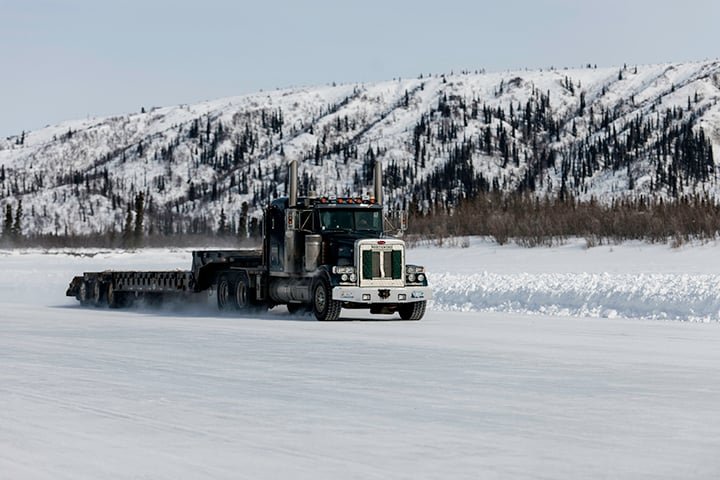
If you are applying for a CDL in Alaska, you likely want to work on the “Slope” (North Slope oil fields). This means driving the Dalton Highway.
A. Separate road guidance from licensing law
CB procedures, convoy practices, survival equipment, and route-specific chain policies may come from employers, dispatchers, land managers, or current road notices. They are not substitutes for the official CDL manual and should not be presented as universal DMV exam rules.
B. Carrier and trip planning
Alaska DMV does not publish a universal CDL-applicant survival-kit requirement. Remote carriers commonly impose stricter equipment policies. Before departure, follow the employer’s written plan and current agency advisories rather than relying on a generic checklist.
- Sleeping Bag: Rated for -40°F or lower.
- Food/Water: At least 3 days’ supply.
- Fuel Additives: “Anti-gel” is mandatory. At -40°F, diesel fuel turns into wax, clogging your filters and shutting down your engine. You must know how to treat your fuel.
- Auxiliary Power: An APU (Auxiliary Power Unit) or generator to keep the engine block warm and the cab heated if the main engine fails.
Wildlife and Incident Response
In the lower 48, you worry about deer. In Alaska, you worry about Moose.
- The Physics: A moose weighs 1,500 lbs and stands on long legs. If you hit a moose in a car or light truck, the body clears the hood and impacts the windshield/cab directly. It is often fatal.
- The Strategy:
- Scan the Ditches: Moose are dark and absorb light. They are invisible at night until you are on top of them.
- Don’t Swerve: On ice, swerving to miss a moose often leads to a rollover, which is more deadly. Brake hard in a straight line. After a collision, protect the scene, request emergency help when needed, and follow current law-enforcement and wildlife-agency instructions. Do not treat an unsourced online “roadkill rule” as CDL test material.
5. Alaska Practice Questions (Scenario Based)
Why? Untreated diesel fuel begins to cloud at 32°F and gels around 10°F-15°F. At -35°F, without sufficient anti-gel additives, the fuel turns into a waxy sludge that clogs the fuel filters, starving the engine. This is a life-threatening emergency in remote Alaska.
Why? Gravel roads present two hazards: dust (zero visibility) and rock spray (windshield damage). Staying 20+ seconds back allows the dust to settle and keeps you out of the "rock throw" zone of the truck ahead.
Why? All big game collisions must be reported. The state manages a list of charities that salvage the meat. Taking the meat yourself without permission is illegal poaching.
Conclusion
Build the application around the official manual, the $15 permit, the 14-day hold, applicable ELDT, and the $25 state commercial road test. Treat remote-road policies as a second layer supplied by the employer and current Alaska agencies.
Official Sources
- Alaska Commercial Driver License Manual (PDF)
- Alaska DMV driver licensing fees
- Alaska DMV Entry-Level Driver Training
- Alaska CDL self-certification requirements
Confirm office availability, credential documents, permit validity, and fees with Alaska DMV before traveling.